
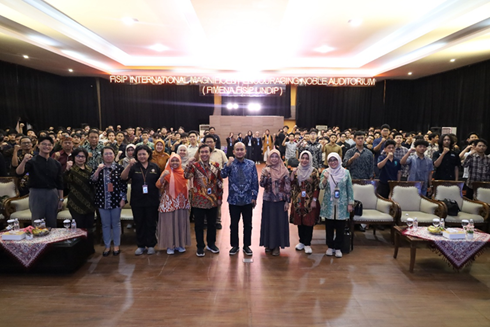
SEMARANG, konselingmahasiswa.undip.ac.id – Universitas Diponegoro (UNDIP), through its Student Care Unit “UPT Layanan Konsultasi Disabilitas Penegakan Disiplin dan Etika Mahasiswa” (UPT LKDPDEM), held a seminar titled “Strong Men, Silent Pain: Membedah Toxic Masculinity and Quarter-Life Crisis pada Pria” The event was held in the Auditorium of Building A, 3rd Floor, Faculty of Social and Political Sciences, UNDIP, Tembalang, on Thursday afternoon, September 4th , 2025, at 1:00 PM.
The seminar featured two experts in their fields: Prof. Dr. nat. tech. Siswo Sumardiono, S.T., M.T., and Hasan Fathur Rozi, S.Psi., M.Psi., who shared insights on mental health, young men’s identity crises, and the social pressures caused by toxic masculinity. Welcoming Speech: Emotions Are Part of HumanityVice Rector I for Academic and Student Affairs, Prof. Dr.rer.nat. Heru Susanto, S.T., M.M., M.T., also delivered a welcoming speech at the event. He highlighted the stigma still attached to men, such as the belief that men should not cry or complain.
“Many men are taught to hold back their emotions, not to cry or share their feelings. In fact, these are natural human expressions,” he said.
He also encouraged students to utilize the services of the UPT LKDPDEM as a safe space to share, consult, and find solutions to various problems they face. “We established this unit to serve students’ needs, not only academically, but also psychologically and socially,” he added. Presentation: Challenges for Men at the Age of a Quarter Century
In his presentation, entitled “A Man’s Journey: The Journey of Finding Strength and Overcoming the Quarter-Life Crisis in Men,” Prof. Siswo explained that 75% of men aged 25–30 experience a quarter-life crisis. He explained that this pressure can arise from within (such as stress or inconsistency in life goals) or from without (lack of social support).
“What we need to do is find a support system, such as friends who understand and are on the same wavelength as us,” he explained.
He also emphasized that the definition of a strong man is not one who suppresses his emotions, but rather one who prepares to face life’s challenges with determination and resilience, while still allowing himself to feel and express them.
Breaking Down the Stigma: Not Weak, Just Human
Meanwhile, Hasan Fathur Rozi, in his presentation “Not Weak, Just Human: Understanding and Dissecting the Stigma of Toxic Masculinity,” explained that toxic masculinity is the result of an excessive and rigid glorification of the male role, which often negatively impacts mental health. “Excessive masculinity can cause men to refuse to experience fear, sadness, or self-care. However, fear is not weakness—it is a signal from the body to prepare for danger,” he said. He emphasized the importance of understanding emotions as part of a survival mechanism, not something to be denied.
Encouraging Emotional Awareness Among Students
This seminar not only provided theoretical understanding but also encouraged participants to be more reflective about their personal experiences as individuals, especially men who are often burdened by certain social expectations.
Presentation: Challenges for Men at the Age of a Quarter Century
In his presentation, entitled “A Man’s Journey: The Journey of Finding Strength and Overcoming the Quarter-Life Crisis in Men,” Prof. Siswo explained that 75% of men aged 25–30 experience a quarter-life crisis. He explained that this pressure can arise from within (such as stress or inconsistency in life goals) or from without (lack of social support).
“What we need to do is find a support system, such as friends who understand and are on the same wavelength as us,” he explained.
He also emphasized that the definition of a strong man is not one who suppresses his emotions, but rather one who prepares to face life’s challenges with determination and resilience, while still allowing himself to feel and express them.
Breaking Down the Stigma: Not Weak, Just Human
Meanwhile, Hasan Fathur Rozi, in his presentation “Not Weak, Just Human: Understanding and Dissecting the Stigma of Toxic Masculinity,” explained that toxic masculinity is the result of an excessive and rigid glorification of the male role, which often negatively impacts mental health. “Excessive masculinity can cause men to refuse to experience fear, sadness, or self-care. However, fear is not weakness—it is a signal from the body to prepare for danger,” he said. He emphasized the importance of understanding emotions as part of a survival mechanism, not something to be denied.
Encouraging Emotional Awareness Among Students
This seminar not only provided theoretical understanding but also encouraged participants to be more reflective about their personal experiences as individuals, especially men who are often burdened by certain social expectations.
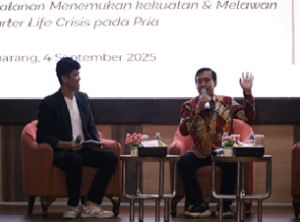 One participant, Rafi, from the 2020 class of Library Science, Faculty of Science, explained that he is not a student who often attends seminars, but he found this seminar very insightful because it rarely addresses the topic of masculinity. “My hope for the UPT LKDPDEM is that they can hold a seminar on masculinity, but also on volume II. Feminism is also welcomed,” Rafi added. The discussion, moderated by Habel Boni Facius Panjaitan, S.Psi., concluded with the conclusion that UNDIP students, both male and female, can develop awareness of the importance of expressing emotions healthily and understand that being strong doesn’t always mean appearing tough. (Jenn)